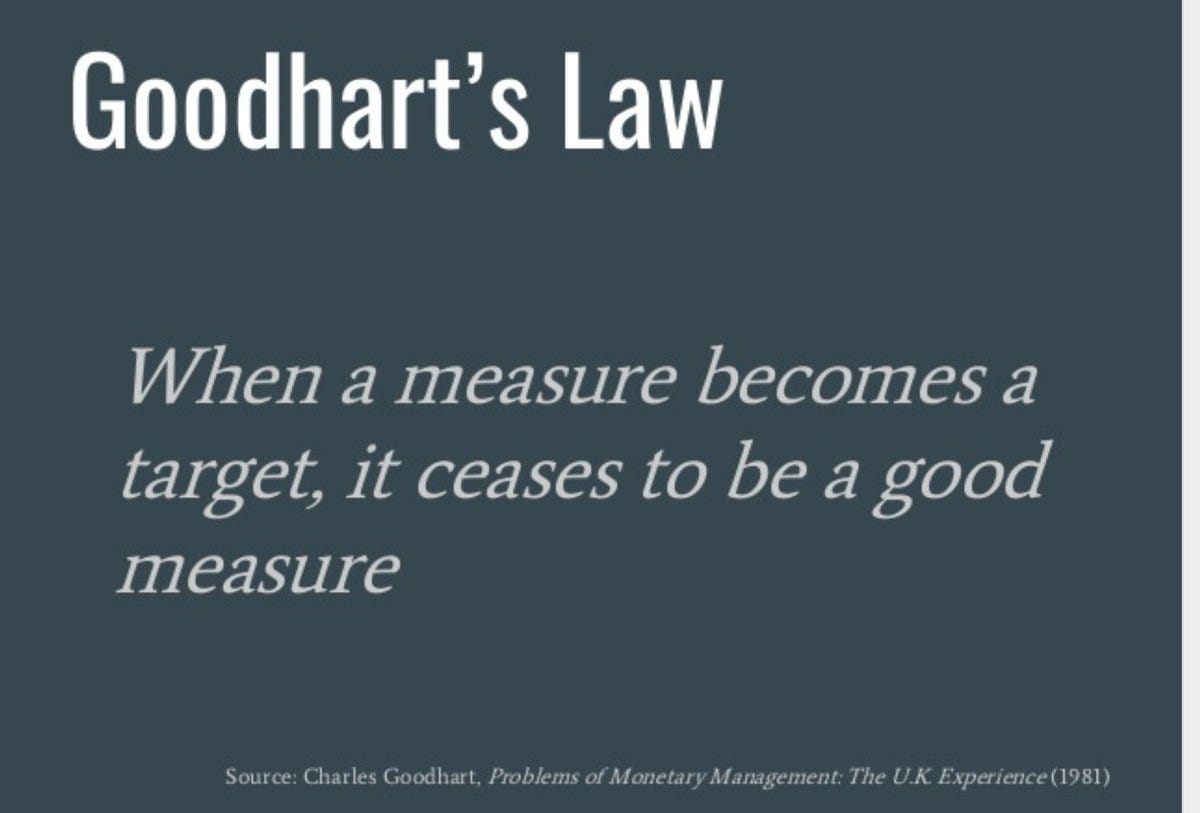
 Harvard professor Ariel Procaccia, writing in The New York Times: “The gap between the rankings and reality can be explained by Goodhart’s law, which says that when a measure becomes a target, it ceases to be a good measure. It’s like trying to cure a fever by icing the thermometer: You’ve cooled the instrument, but the patient is still burning up. China has made success in global university rankings a national policy goal, in the process creating incentives that prioritize the appearance of excellence over the health of the research environment. For a long time, it was common for Chinese universities to award cash payments for publications to boost the share of papers their researchers published in international journals; the more prestigious the journal, the higher the payout.” Read the full commentary (gift article) here
****************
“Coined by economist Charles Goodhart in 1975, this principle highlights that when a metric is used to reward performance or set goals, it incentivizes manipulation of that metric rather than improvement of the actual underlying system, leading to distorted outcomes.”