To force students to walk through the doors of a public school named after an enslaver makes slaves of us all.
“Segregation is not a proud moment, but it is in the past,” so declared a defense attorney for the Shenandoah County (VA) School Board. He made that statement during opening arguments in the Federal trial concerning the Shenandoah County School Board’s renaming of two public schools.
After a prior board replaced the names Stonewall Jackson and Ashby-Lee with Mountain View and Honey Run, the present school board reinstated the Confederate names. Five students sued the current school board for violating their civil rights.
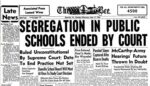
Courtesy Danville Register & Bee
Of course, the defense attorney is technically and legally correct: segregation in public schools became illegal in 1954 by the Supreme Court’s Brown v. Board of Education decision. It was a unanimous decision against the “separate but equal” doctrine that had existed.
But if we scratch below the technical and legal argument, is segregation in our public schools and our culture “in the past”? Of course it is not.
As an educator for over forty years, I observed one common element in them all. I called it the hallway culture, where there was little direct adult supervision, and students would act out against one another. It was where–be it in a hallway, bathroom, locker room, or cafeteria–bullying of many types took place. It was where a student would be “cut from the herd” because of their clothes, language, skin color, name, or any other characteristic that was used to ridicule the student as “different.” For example, a Latino student (no matter his name) might be called “Pedro.”
For ten years, I was Dean of Students at an all-girls high school. There, the silence, stare, or other look between girls could be brutal. The “hallway culture” would drive students to my office, where they would describe the behavior, then cry, and say they felt ostracized.
Teachers will tell you how difficult it is to deal with unobserved behavior, that is, when a person of authority did not witness it. So, how did I assist students who came to me? I tried to help those students develop the capacity to deal with bullying, to deny bullies the power/control they craved.
I bring up bullying behavior because it exists in community culture, too. Bullying is not about doing the right thing; it is about imposing one’s will on others.
With that in mind, we should not demand that a student enter a building named for someone who died or fought for the right to enslave other folks. Doing so is a misuse/abuse of power. Like students who bully others, a public entity intentionally segregates, isolates, and ostracizes students who are different.
And for what purpose?
In May 1954, the Supreme Court ruled segregation in our public schools illegal. The attorney quoted above is correct that it was “not a proud moment.” But any sentient being living in America today knows that it is hardly “in the past.” It — and its related manifestations — exist today.
ROBERT E. LEE HIGH SCHOOL: “Bears the name of our beloved Confederate general and educator. It is he who said, “Duty is the sublimest word in the English language.” May those words inspire each student to do his (sic) duty always. Never by word or deed do anything to discredit the name of this great man.” Posted on the outside wall of an Alabama high school until it was removed five years ago (photo courtesy The Equal Justice Initiative)
Indeed, to force students to walk through the doors of a public school named after an enslaver makes slaves of us all.