Believing that the world today is in worse condition than any other historical time shows, I think, a wrong interpretation of past events, or perhaps just a misunderstanding. Let me explain.
For instance, imagine living during any of the plagues, or being Irish during Cromwell’s reign, or surviving under Apartheid, or trying to remain alive during the Armenian Genocide. Also consider many other truly harsh and evil periods in human history.
Yet I contend that several current conditions around the globe reveal the darker side of some elected governments, autocratic regimes, and some citizens as well. Ukraine and Gaza are shadows of their former selves. Israel bombs and is bombed. Iran’s Ayatollah murders protestors. Children starve across drought-stricken regions. Refugees are denied entry to safe havens. It seems that the world today moves from one danger (COVID) to another.
But I recently read two books, both set in the present-day world, that offer hope. Read them side by side as a study of our shared humanity and the hope that holds for us.
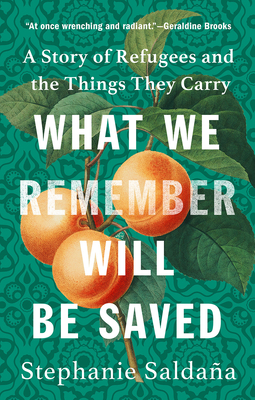
Amazon Kindle, 2023
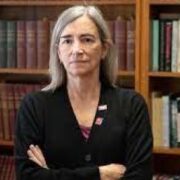
In What We Remember Will Be Saved: A Story of Refugees and the Things They Carry, Stephanie Saldana (featured in the cover photo) has recorded stories of refugees and the items they carried when fleeing their homes. Think what you would pack if I told you that in fifteen minutes you had to leave your home—what item(s) would you grab, because fifteen minutes is not enough time to pack.
As Saldana writes, “You don’t think about what you can bring when you escape your city at four in the morning.” She tells the stories of six ordinary citizens from Syria and Iraq who are forced to vacate their homes and flee, looking for a haven. One takes a violin, another just a memory of ancestor names, and another, while sheltering in Jordan, sews a dress to show her life before emigrating to Australia. When in Amsterdam, Saldana is asked by Ghadir, a refugee of Aleppo, what she is writing about, she answers, “I write about … tangible and intangible things, like the soap of Aleppo. Or rose petal jam. The jasmine of Damascus. Or the Muwashshah music.”
During their journeys, the refugees face hostile governments they must navigate, yet they maintain dignity, resilience, respect, and a memory of what was before. Saldana writes, “When the places you love begin to disappear, you begin to live in them all the time.”
“I surrendered to what was given to me,” said Ferhad, a young Kurdish musician, to Saldana. He had fled Al-Haaken, Syria, and made his way to Istanbul, where he and a friend formed a band. There he met Mar, whom he later married, and they moved to Spain, where they lived and restored her family home.
Moving to England for her studies, Ferhad learned his fifth language after Arabic, Kurdish, Turkish, and Spanish, several years after escaping Syria during his last semester as a student. At the time of the book’s writing, he was a cook at a Lebanese restaurant, where he manned the kitchen and mopped the floors. Mar and he rent rooms in a small English cottage with a garden.
And think about America’s President ridiculing such people as Ferhad. But a different reality prevails: Ferhad is one of many who would improve any place by his presence.
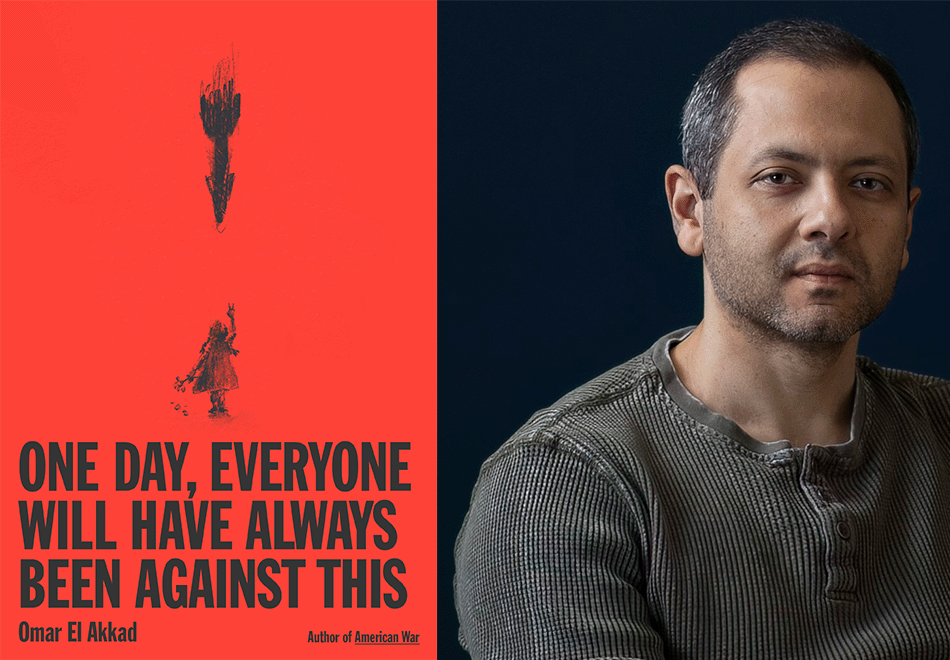
While Saldana writes of the refugees, the victims, Omar El Akkad writes of the imperialist, the reasons behind the victims. In late October 2023, the novelist Omar El Akkad tweeted these words as a caption for a video he re-tweeted:
“One day, when it’s safe, when there’s no personal downside to calling a thing what it is, when it’s too late to hold anyone accountable, everyone will have always been against this.”
That tweet has been viewed over ten million times. A Gazan man retweeted a video he had taken, showing rubble that had once been full of life but now held none.
El Akkad demonstrates how the Gaza man’s video expands into much more because of Western imperialism. His caption began with Gaza’s destruction, but his book condemns the genocides taking place across the globe, the genocides that are directly or indirectly a product of Western imperialism.
El Akkad does not forgive any of the people engaged in the violence. Still, he asks the reader to consider the observers (American politicians of all stripes), the passive supporters of such destruction:
“Look instead at the faces of those who watch from the sideline. Often, what you’ll find is not an expression of proud support or the shock and horror all these people will claim to have felt much later, after the verdict is in. Rather, you’ll see a childish little smirk. It’s the smirk of someone who has come to realize the ugliness of the enterprise they have passively aligned with but cannot muster the courage to abandon now. The soul, what’s left of it, buckles under the weight of contradiction, and all one must do is hide behind that pained little smirk, the half-stance of the spineless, the chanting, with not quite enough conviction, of four more years, four more years, as the bodies pile up outside one’s door.”
Gaza, yes, but El Akkad also writes of Fergerson, wars on terror, climate change, Black Lives Matter, Vietnam, and Guantanamo Bay. Early in his book, he explains, “This is an account of something else, something that, for an entire generation of not just Arabs or Muslims or Brown people but rather all manner of human beings from all parts of the world, fundamentally changed during this season of completely preventable horror. This is an account of a fracture, a breaking away from the notion that the polite, Western liberal ever stood for anything at all.”
Perhaps El Akkad’s condemnation of Western liberalism was recently borne out by the President of the United States of America, who spoke to a captive audience of service members at Ft Bragg. About the Venezuelan raid, the President said, “The entire world saw what the full military might of the U.S. can do.”
I believe El Akkad would ask the speaker: If wars and conflicts are so good, why do we continue to wage them? It is all ‘preventable horrors.”
Those are two books to read, but let me also recommend two more that, through their stories, offer hope:
How to Share an Egg: A True Story of Hunger, Love, and Plenty by Bonny Reichert
Where the Children Take Us: How One Family Achieved the Unimaginable by Zain E. Asher