The waiter sets the glass down too carefully.

Photo courtesy Freepik
It is one of those small gestures that look rehearsed even when they are not. His hand pauses for half a second longer than necessary above the table, as if confirming the placement, as if confirming himself.
The couple at the table barely notices. They are mid-argument, speaking in the compressed shorthand that only long familiarity allows. The waiter leaves, but the image of him lingers in the background of their exchange, like a faint moral commentary neither of them asked for.
Later, one of them will say: he was being fake. Too polite. Too precise. Nobody actually cares that much about a glass of water.
But that judgment depends on a hidden confidence: that “caring” would look different if it were real.
That is where the trouble begins. Because what would it mean for the waiter to “really care”? About this couple? About the glass? About the job?
The easy answer is that he does not care, that he is performing service, that his attentiveness is a mask worn for tips and wages. This is the standard reading of bad faith: the self split from its role, the interior truth hidden beneath outward form.
But the waiter leaves the frame, and the couple remains inside their own argument, where the same problem appears again, only more intimate.
She says he does not listen.
He says he does listen, but he disagrees.
She says that is not the same thing.
He says she is changing the meaning of “listening” to make him seem wrong.
Neither of them is lying in any simple sense. And yet, at different moments, both of them feel the other is not being genuine and not really listening. Not really trying and not really understanding. The accusation of bad faith circulates between them, waiting for one to flinch. Ready for one to assume the other is not rational. Ready to make a finding of bad faith.
This is the world of neoclassical economics, of homo economicus, where agents are assumed to act rationally under incentive.
But what is the incentive?
The argument escalates, but not only disagreement. It is interpretive certainty. Each begins to narrate the other as someone who is performing a relationship rather than inhabiting it. And once that narrative takes hold, everything becomes evidence. A pause becomes evasion. A clarification becomes deflection. A compromise becomes a strategy.
At some point, one of them says: You’re just saying that. It has become a game of tit for tat.
This is where a different analytic tradition becomes more relevant. Power does not simply constrain action externally; it organizes the field in which action becomes intelligible at all. The categories through which we interpret behavior—sincerity, manipulation, authenticity, role-playing—are not neutral descriptors.
Social hierarchies and institutional contexts structure them. What counts as “just performing” is often distributed asymmetrically across status positions. Those in subordinate roles are more frequently read as performing their identity, while those in dominant positions are more readily granted sincerity. The interpretation of bad faith is therefore not evenly applied. It follows lines of power.
Once this is recognized, suspicion itself begins to appear in a different light. The speed with which we attribute ulterior motives, strategic behavior, or insincerity is not evidence that we have escaped naïveté. It is evidence that we are already embedded in a shared interpretive system that makes such judgments possible.
Suspicion is not the absence of trust. It is a derivative form of it. We trust that actions are sufficiently coherent to be interpreted at all. We trust that intentions can be inferred from behavior. We trust that deviation from expected patterns is meaningful rather than random. Even cynicism depends on this background confidence in interpretability.
The waiter, the couple, the glass of water, the accusation—they are all part of the same structure. A structure in which meaning is assumed, tested, and revised, but never escaped.
Jean-Paul Sartre called one version of this structure bad faith. In his account, people flee from the burden of freedom by identifying with fixed roles: the waiter who is only a waiter, the lover who is only a lover, the self reduced to an object. Authenticity, for Sartre, requires resisting this collapse into role, refusing to confuse what one does with what one is.
Modern social systems are reflexive: people adjust their behavior in response to how they are interpreted. Once you know you are being read as “performative,” you begin to manage that perception. This is where bad faith becomes self-reinforcing—not as psychological error, but as structural feedback.
At this point, interpretation is no longer about uncovering truth beneath appearance. It becomes part of the system of production and appearance itself.
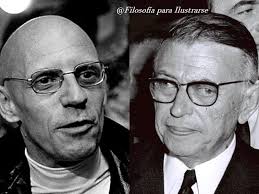
Michel Foucault and Jean-Paul Sartre (graphic courtesy Filosofía para Ilustrarse)
This is where existentialism and Foucauldian theory diverge sharply. Sartre imagines a subject who can, in principle, achieve lucidity about their own self-deception. Foucault suggests that subjectivity is produced by systems that precede and exceed individual transparency.
Neither explains why, as humans, the simple answer, our preference, is to respond in kind. To attempt reason when we are out of reason.
If we shift the frame slightly, something else appears. The waiter is not simply over-identifying with his role. He is also navigating it. The precision of his gesture is not necessarily an existential mistake; it may be a matter of professional competence.
The performance is not necessarily a mask hiding a more authentic interior; it may be the very medium through which social life is conducted. The question is no longer whether he is being authentic, but why authenticity has become the standard against which his behavior is judged in the first place.
This is where power enters, not as an external force distorting an otherwise neutral self, but as the field in which interpretive categories become available.
What counts as “just performing” is not evenly distributed. Service work is more readily read as performance than managerial speech. Emotional labor is read as inauthentic more readily than institutional authority. The language of authenticity often travels downward, attaching itself to those whose actions are already structurally exposed to scrutiny.
The couple, too, is not outside this dynamic. Their argument is not only about feelings; it is about legitimacy. Each is trying to secure the authority of their interpretation of the relationship. Each accusation of inauthenticity is also a claim to define what the relationship “really” is. And so bad faith becomes a tool of negotiation, a way of stabilizing uncertainty by attributing it to the other person’s failure to be genuine.
But the deeper paradox is that this only works because both still believe the relationship is intelligible. If they did not trust that words, gestures, and silences carried meaning, there would be nothing to argue about. Even the most cutting accusation—”you don’t really mean that”—is an appeal to meaning and objection to being accountable for bad faith.
The couple can only accuse each other of bad faith because they believe that faith, sincerity, and intention are real distinctions that structure behavior. The waiter can only be read as “just performing” because an assumed difference between performance and reality exists. The entire system depends on the stability of these distinctions even as it constantly destabilizes them in practice.
This is why cynicism never fully exits the structure it critiques. To say that someone is only performing is still to participate in the expectation that performance can be identified as such. To say that relationships are strategic is still to assume that strategies can be read. Even the most aggressive suspicion relies on a background confidence that interpretation is possible.
If there is a reversal here, it is this: the quickness to infer bad faith is not evidence of superior perception. It is evidence of trust that there is a shared world where actions are assumed to be meaningful enough to be misread. Trust does not disappear when suspicion appears. It becomes the invisible infrastructure of suspicion itself.
Bad faith is not primarily a trait we detect in others; it is a heuristic of interpretation we use to stabilize uncertainty. It is a way of concluding that we know what we cannot actually verify: another’s intention, sincerity, or interior alignment with their role.
In that sense, bad faith functions less as insight than as a cognitive shortcut—a parlor trick of inference that converts ambiguity into legibility. We treat it as a revelation, but it is closer to a hypophora in disguise: the question “Are they really sincere?” is posed only so that an answer can be assumed in advance. In that sense, bad faith is less insight than a sign that you are no longer reasoning from what can be verified, but from conjecture.
The waiter continues moving between tables. The couple continues arguing. Nothing settles into resolution, because nothing in it was ever fully measurable.
Bad faith is not an equation; it is what appears when certainty substitutes for evidence.
__________
Cover graphic courtesy of Brent Antonson at Planksip