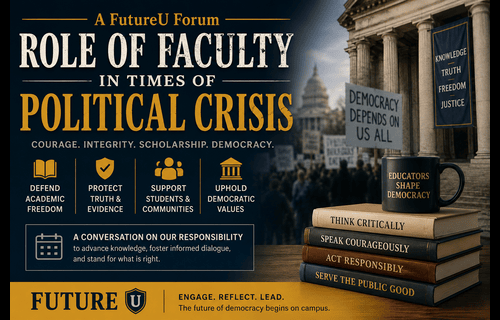
 During ordinary times, scholars and faculty members at colleges and universities have the dual responsibilities of pursuing knowledge, engaging in critical thinking, and fostering intellectual growth on the one hand and, on the other, preserving human dignity and participating in public discourse on critical societal issues.
Today, American Democracy is under a coordinated assault that undermines democratic practices and promotes authoritarian rule.
The question that arises is “What should be the role of scholars and faculty during these dark times?” Should they remain silent about the undermining of democracy, or should they shed light on the steps taken toward authoritarianism and the dangers they pose to American society?

Jennifer Ruth
Professor Jennifer Ruth. Jennifer Ruth is a professor of film studies at Portland State University. She writes extensively about academic freedom and higher education in outlets such as The New Republic, Truthout, Academe, Academe blog, Chronicle of Higher Education, Inside Higher Ed, and LA Review of Books. She and Michael Bérubé have co-authored two books on academic freedom: The Humanities, Higher Education, and Academic Freedom: Three Necessary Arguments and It’s Not Free Speech: Race, Democracy, and the Future of Academic Freedom. Professor Ruth is also the co-editor, with Valerie Johnson and Ellen Schrecker, of The Right to Learn: Resisting the Right-Wing War on Academic Freedom, winner of the AAC&U Best Book Prize 2025. She is the director, with Jan Haaken, of the film The Palestine Exception: What’s At Stake in the Campus Protests?
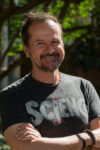
Adrian Lenardic
Professor Adrian Lenardic. Adrian Lenardic is a Professor of Earth, Environmental, and Planetary Sciences at Rice University. He teaches courses in modeling and design, visualizing nature, and planetary science. His research focuses on geodynamics, geophysics, and planetary science, particularly interactions between Earth’s interior and surface environments, model development, and tectonic processes. He was born in Zagreb, Croatia (and rarely misses a Croatian soccer match). His BSc is from UW-Madison, where he was an art major before switching to physics. His PhD is from UCLA, where he was introduced to planetary science. Adrian’s scientific research focuses on understanding interactions between the Earth’s interior and surface environments, model development, and multiple tangent meanderings.

John W. Traphagan
Professor John W. Traphagan. John W. Traphagan is Professor Emeritus of Human Dimensions of Organizations and Anthropology at the University of Texas at Austin. His academic career has spanned anthropology, religious studies, and the cultural dimensions of science. He has held positions at the University of Pittsburgh, the University of Michigan (as a National Institute on Aging Postdoctoral Fellow and research affiliate), and California State University, Fullerton. He has been a visiting scholar at institutions including Arizona State University, Waseda University, Clark University, the University of Pennsylvania, and the University of Massachusetts Lowell. His publications include Rethinking Autonomy: A Critique of Principlism in Biomedical Ethics (2013), Cosmopolitan Rurality, Depopulation, and Entrepreneurial Ecosystems in 21st-Century Japan (2020), and The Myth of Organizational Culture: How Leaders Misunderstand the Role of Paradigms and Power (2025).
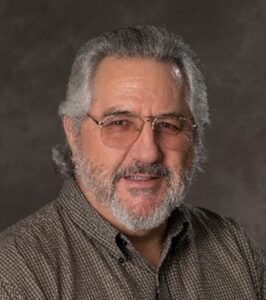
Rubén O. Martinez
Hosted by Emeritus Professor Rubén O. Martinez. Dr. Martinez is an emeritus professor at Michigan State University, where he also served as director of The Julian Samora Research Institute. He is the editor of the Latino in the United States book series and has published several books, including a special issue titled Diálogo on Latina/os in the Midwest and co-edited a volume of Occupational Health Disparities among Racial and Ethnic Minorities: Formulating Research Needs and Directions. He has co-authored several other books, including A Brief History of Cristo Rey Church in Lansing, MI, Chicanos and Higher Education,” and Diversity Leadership in Higher Education. Professor Martinez led a group that founded FutureU in 2015.
Professor Nathan Rousseau
Professor Nathan Rousseau. Nathan Rousseau is a Professor of Sociology at Indiana University, Columbus. He teaches courses in Social Theory, Sociology of Mental Illness, Social Factors in Health & Illness, Sociology of Death & Dying, and International Virtual Exchange courses with colleagues at Newcastle University, UK. His scholarly work includes social history, education, and neoliberalism. He received the President of the United States Bronze Community Service Award (2016), the City of Jacksonville Community Service Award (2014), and CHOICE recognition of Society Explained: An Introduction to Sociology as one of the top 25 Academic Titles of 2014. He is currently working on a book entitled Normalizing Precarity in Higher Education: Universities and the Neoliberal Society (Routledge). His current research is on race and ethnic relations and neoliberalism in higher education.
WATCH THE VIDEO ON OUR YOUTUBE CHANNEL
Video produced by Frank A. Fear, professor emeritus at Michigan State University and Managing Editor of FutureU. Audio music, “Interview,” courtesy Audiostock via Wondershare Filmora.

From The Authoritarian Playbook: Professors Defend Academic Freedom (KALY, Bay Area, 91.7 FM)



: Role of Scholars/Faculty in Times of Political Crisis)