You may have seen or read the September 19 article published in the New York Times about AI and college students. “Students are using artificial intelligence for everything, including cheating, and a recent M.I.T. report said the technology was creating “cognitive surrender.” And yet, many higher education leaders are embracing AI.
I wasn’t listening to the commercial for a computer program until I heard this phrase: “…turning data into intelligence.” In my experience, most companies fudge accuracy and/or make unrealistic promises when advertising their wares or services, so I usually ignore them.
Still, this statement seemed to go beyond fudging and into the realm of the miraculous. But as an eighty-year-old baby boomer, I may “Just not understand” the innovations and possibilities. I may even seem a bit old-fashioned because I still cringe when I hear or read the word “quote” used as a noun, as in “The quote was long.”

Source: Great Learning
Curious about this company’s claim, I opened my computer, went to Google, and typed, “What is data?” Immediately, an AI answer appeared: “Data is a collection of discrete or continuous facts, numbers, words, or observations that convey basic units of meaning.”
The site continued by explaining the main types of data, but I found the definition above accurate and did not validate the AI by checking other sources. I returned to my computer and typed in a request for a definition of intelligence. I read this reasonable definition from Merriam-Webster: “the ability to learn or understand things or to deal with new or difficult situations.”
Wow! All this information is at my fingertips. No thumbing through the pages of a cumbersome dictionary or a trip to a library. I typed in a question, and there was an answer, and this time a correct one.
As I told you earlier, I am a baby boomer who, years ago, had to use books and a card catalog in a library and walk to a stack to retrieve the book … hoping the one I wanted was placed correctly or not checked out. Still, if all that failed, I would ask my teacher or someone in authority for help.
Oh, how awkward those days!
Not only is all this research convenience right at my keyboard now, but a large company tells me that hardware can turn data into intelligence. I take that to mean I will no longer have to study a chart, graph, or spreadsheet to draw a conclusion. A machine will do it for me.
And as someone challenged by this process, I am tempted to sign on. But then I remember a few people or writers I have encountered, enjoyed, and learned from. So I will narrow it to three and share what I learned from them.

Photo courtesy St. Martin’s
The first is a math teacher at St. Martin’s Episcopal School near New Orleans. When I first examined the grading system for her geometry class (I was the new head of the upper school), I was confused. I asked her why she gave a full ten points if a student showed their work for homework problems but got the answer wrong.
Jane carefully explained that she wanted her students to learn the value of the process of working geometry, not just rush for an answer. She awarded their process, and her students learned the value of doing instead of getting.
Next is Sydney J. Harris, a syndicated columnist who wrote Strictly Personal, his daily column in the Chicago Daily News. Each week the local Charlotte Observer printed a column, and I wish we had his type and style today.
“What I Learned Looking Up _______” was a favorite column of mine. He would explain how he would look up a particular word in the dictionary, only to have his attention drawn to the word immediately before the intended one, the word across the page, or the word after it. In my search above, if I had looked up the word “data” in my dictionary, I would have seen the word dasyure just before it and learned that it is a marsupial mammal.
The point is that in a fast-paced computer search, learners miss an opportunity. As with Jane, the math teacher, the process is more valuable for learning.
Source: The Orwell Foundation
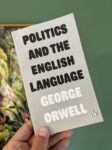
Last, there is George Orwell, who wrote in his 1946 essay, Politics and the English Language: “Modern English, especially written English, is full of bad habits which spread by imitation, and which can be avoided if one is willing to take the necessary trouble. If one gets rid of these habits one can think more clearly, and to think clearly is a necessary first step toward political regeneration: so that the fight against bad English is not frivolous and is not the exclusive concern of professional writers.”
To think clearly, to reason independently, is a skill we all wish for. Jane’s geometry students worked for clarity of understanding, learning that their process would lead them to understanding. Harris shared his adventures in learning, the thrill of discovering something not sought, but a nugget found hidden on a page. Orwell warned us of the danger of bad English.
But I fear we approach, if we have not already crossed, the Rubicon of being manipulated by the tech world giants.
As concrete behemoths dot our landscape, their owners gobble up unfathomable riches as they make logic-jarring promises about what they will do for us only if we subject ourselves to them.
Faster is better, they say, and their self-serving, money-producing technology will, in some strange manner, benefit us. Just consider the example from the commercial I quoted above: “turning data into intelligence.”
What we are being sold is not intelligence, but a mirror (plagiarized?) of our work. Like in all greed-driven hustles, the buyer is a victim who may think that the offer contains something for nothing.
It’s an old scam. Let’s not cross that river.
_____________
Cover graphic courtesy of The Sunlite Desk on WordPress.com